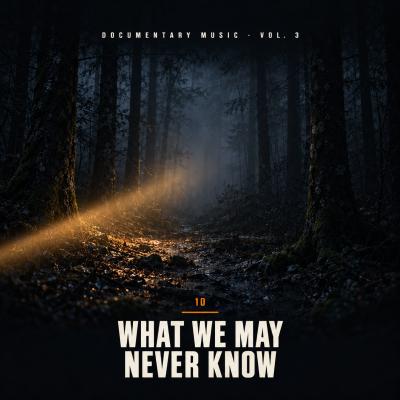
Documentary Music - What We May Never Know
This song will be released in 2 weeks. Please check back later.
Delicate felt piano and deep, evolving synth pads set a pensive, mysterious atmosphere, enriched by warm French horn swells and a mournful solo woodwind melody. Unhurried and introspective, the arrangement moves from sparse stillness to a gentle arpeggiated pulse—ideal for investigative documentaries, historical deep dives, scientific storytelling, and reflective drama scenes.
About this track
Built around the interplay of intimate, reverberant piano and wide, dark-hued synthesizer pads, this composition establishes a contemplative, quietly investigative tone from its opening seconds. Rather than relying on heavy orchestral tuttis or busy percussion, the production favors spacious hybrid textures where every note has room to decay. The piano timbre is soft and felted, sitting gently inside a cavernous stereo field alongside low, breathing bass drones. Warm swells from a solo brass horn and an expressive, breathy woodwind—reminiscent of an alto flute or duduk—add an organic, human vulnerability that contrasts against the cool synthetic backdrop.
The dynamic arc unfolds with deliberate patience. During the opening minute, isolated piano notes hang suspended over shifting sub-bass foundations until a solemn horn rises out of the mist around 00:35, punctuated near the one-minute mark by a muffled, distant drum pulse. At 01:06, the piece finds its central momentum as the piano transitions into a steady, hypnotic arpeggio. Over this harmonic bed, the solo woodwind enters with a mournful, lyrical melody that carries the emotional weight of the middle section. By 02:11, the woodwind recedes and the piano shifts into a slower, questioning motif supported by subtle brass swells, before stripping back at 02:45 to solitary piano phrases and a final, fading low-end drone.
Because the arrangement leaves the midrange uncluttered and avoids sudden transient spikes, it functions exceptionally well beneath spoken narration and dialogue. Documentary filmmakers and podcast producers will find it naturally suited for investigative journalism, unsolved mysteries, historical retrospectives, and serious scientific or environmental features. In narrative film and television, it supports quiet character reflection, aftermath sequences, or slow aerial cinematography over isolated landscapes.
What makes the cue so practical in an edit suite is its balance of emotional gravity and restraint. The shift from beatless suspension in the first minute to the measured piano ostinato in the second gives editors a natural gear-shift for transitioning from a cold open into the main story, while the sparse final thirty seconds provide a clean, unresolved finish.
Classification
Find similar →Tags